
Friday, March 5, 2010

Who's Really Cashing-in on Fantasy Sports?

It's amazing that more attention isn't paid to the rise of online fantasy sports. Today's marketing dollars aren't just shifting towards digital media, they're starting to flood social networking sites where user segmentation and data are practically spoon fed to marketers. But while video sites like Hulu and Youtube are reaping the benefits, there's still dozens of other networks that, for one reason or another, still aren't being tapped for their full potential. Case in point, fantasy sports.

Industry Overview

According to the Fantasy Sports Trade Association [FSTA], the industry generates around $1 Billion in annual revenue, on everything from branded content to subscription fees. And when you include the sports, media, and retail stakeholders that also benefit from fantasy participation, some estimate the industry's influence at around $4 Billion. Considering the steady rise in online participation, these stats don't seem too far fetched.
Some semi-recent numbers suggest that over 27 million people in the US (11% of the population) have taken part in some kind of fantasy sports league - and there's no shortage of Millennial males in that number. In fact, my friends and I just drafted our teams for "Live Free or Slide," a 14-team fantasy baseball league on Yahoo! Sports. With team names like "Morning Millwood" and "Designated Twitters," you can assume the league is pretty casual (despite the $20 buy-in). But for advertisers trying to reach this male demographic, the payoffs of fantasty baseball could be absolutely phenomenal - when played correctly.
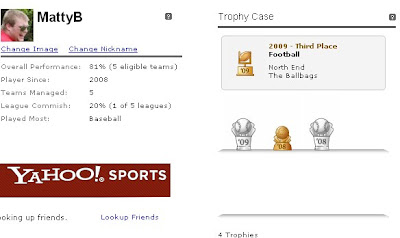


The Industry's Players

As the
industry market leader, Yahoo seems to appreciate the potential of fantasy sports. Fast Company notes that online sports content is a "gold mine" because it's consumed largely by "the highly desirable demographic of men between the ages of 25 and 49." According to the article, it's the ad revenue that Yahoo is after; online sports content could generate as much as $1.1 billion by 2011.

Update: March, 2010

Since beginning this post in March 2009, it seems like more and more marketers are catching on. Of course, while Yahoo! Sports is still the 800 lb gorilla in the fantasy sports arena, sports fans will probably recognize some other examples:
CBS Sports: The popular choice for NCAA college basketball stats and brackets Notably, they have a March Madness Facebook app that lets users to compare their bracket picks with other friends in the pool.

ESPN: The self-proclaimed "Worldwide Leader in Sports" no doubt has the revenue and media resources to take over the fantasy sports world from Yahoo. But because it came late to the party, it needs to do something that really sets it apart. Having never used the ESPN site, I can't comment either way. If you've used ESPN fantasy before, feel free to leave a comment below and let me know what you think.

NFL: If you're a football fan, you've probably seen the big push to drive site traffic - the tagline "If you want the NFL, goto the NFL." Once again, I have absolutely no idea what kind of advantages their setup might offer over Yahoo's. But, as is the case with ESPN, the NFL is just too late to the game.

Why Fans and Marketers Love Fantasy Sports

Consumer Engagement is the key to understanding the value of Fantasy Sports - for everyone involved. In a blog post about ESPN, a former ad-bro of mine called the network: a hyped-up, overwritten, Emmy-winning gossip show for men" about "the oldest, most original reality show there is: Professional sports." And here's the thing - he's completely spot on. As ESPN and the NFL Network continue to process professional sports into digestible, pre-packaged narratives, fans across the country get more and more involved into story-lines that never used to matter. In an excerpt from Eating the Dinosaur, Chuck Klosterman says:

In essence, the NFL Network works exactly like FOX News: It stays on message and invents talking points for its core constituency to absorb. If Donovan McNabb is temporarily benched for Kevin Kolb during week ten of the season, that decision is turned into a collection of questions for football people to ponder until Sunday. How will McNabb react? Is his career at a crossroads? Has Eagles coach Andy Reid lost control of his offense? How will this impact your fantasy team? These are the ideas football fans are supposed to talk about during the run-up to week eleven, and the NFL Network ensures that those debates will be part of the public discourse.

(It's also worth pointing out that J.Dubs' ESPN insights came along before Klosterman's).

But this is exactly the point. Avid sports fans gobble up this male-equivalent of TMZ Gossip because outlets like ESPN and the NFL Network have made it part of our discourse. And with the rise of fantasy sports, these narratives seem to have become more essential. In the good old days, we only had to care about our Home Team. But thanks to fantasy sports, fan engagement has blown through the roof. Now, I not only have to keep tabs on the Red Sox, but also the dozen+ players on my Fantasy Team spread throughout countless MLB divisions.

Red Sox games used to be the only ones that mattered. But all of a sudden, I find myself watching games because I want to see if my closer Joe Nathan (Twins) gets the save or Nyjer Morgan (Nationals) gets another stolen base. These are NL players that never mattered to me - but that was before I drafted them. Their success is the key to mine. Thanks to fantasy sports, the MLB suddenly has fans from around the country viewing more games. I mean, if it weren't for all those managers with Nyjer Morgan on their squads, who else would be watching a brutal Nat's games? Surely not the folks on The Hill.

Fantasy Sports adds a whole new level of engagement to professional sports - and marketers are finally beginning to understand that. ESPN lists fantasy stats on TV. Rotowire syndicates their fantasy data online. The NFL pushes its viewers to NFL.com for research. If people are eating this crap up, they might as well make money off it. And as marketers get a little more creative on how to monetize digital content, we'll see even more resources chasing that potential revenue - and why not? Everybody wins.

~ Marketers generate sponsorship and ad revenue.
~ The MLB finally becomes more essential to its fans.
~ Sports bros have more gossip to obsess over.
Seriously, everybody wins.

And while I use baseball as an example, this exact same phenomenon takes place during football and basketball seasons as well. Personally, I'm even more obsessed during the NFL season. Ask me how badly I hate Jay Cutler right now. I dare you: http://www.youtube.com/watch?v=LXLq1Vy4llw

What do you think about the growth of fantasy sports? The leagues - the Resources - the Gossip and conversation surrounding it? Are fantasy sports only beginning to hit their stride?

What about the battle for market share? do you think any site can overtake Yahoo! Sports?

Hit Me.

------------------------------------------

Want some Bonus Reading?

http://money.cnn.com/2006/08/11/news/companies/fantasyfootball/

Wednesday, March 11, 2009

Shouldn't We All Be on Match.com?

Online dating used to carry a pretty significant stigma. Of course, so did sleeping with someone before marriage. Needless to say, our dating culture has changed, and so have the resources we use to do it. I think we all have a tendency to associate online relationships with perversion and Dateline documentaries. But given the depth and variety of our current web interactions, it seems illogical that a site like match.com isn't yet a gen-y staple. Let me explain.

The average 20-something has a username on dozens of different sites - from ebay to someecards.com. Even further, a good number of those sites are social networks, designed to link millions of users together for various reasons. There's a social network for everything:

Facebook/Myspace: peer-driven social networking

Linkedin: professional networking

Twitter: real-time info and idea sharing

Blogger/Wordpress: blogging

AIM/G-Chat: instant messenging

Youtube: user-generated video

Yahoo/ESPN: fantasy sports

And these are just the major networks - other niche sites like Current (user-ranked media), Mashable (online media), DeviantArt (art), and even My.BarackObama are loaded with gen-y users who are at risk of exploding they're so goddamn connected.

Now let's take it one step further. Social networks are founded on the idea that users want to share a little piece of themselves (or a huge, awkward piece) with the world. Across sites, it's true that the info, ideas, and media we share are all carefully chosen to reflect who we are. We upload our funniest videos and remove unflattering pictures. We wall-post some messages and privately send others. We let some users see our info, and block it from others.

Every social network broadcasts a certain piece of who we are - or think we are. The only difference is who's listening.

Facebook shows our social side, even when we're consumed with work.
Twitter shows our ideas and media tastes even when we don't tweet for days.
AIM and G-Chat show away messages even when we're long-gone.
Linkedin shows our professional profile, even when we're not job-hunting.

Shouldn't Match.com show our relationship preferences...even when we're not looking?

The fact is, flirting, courting, and relationships are a huge part of the 20-something lifestyle. Most of us spend a lot more time courting a significant other than we do job-hunting. Doesn't it make sense to create a profile that shows your softer, more romantic side? If everybody had online dating profiles, it help prevent the awkward combination of chatting and flirting that haunts facebook. Instead of initiating a creepy facebook poke, suitors could wink through Match.com - a network designed for courting.

Already in a relationship? No problem, why not declare it through Match.com and show off all the commonalities you share with your significant other. Do you two only share 6 levels of compatibility? Uh oh, your friends will be the first to tell you that the relationship isn't going anywhere.

Status Updates:

Exploring? Click a green dot beside your profile name.
Not really looking? put a yellow one.
Taken? Add a red dot (and the person's name if you'd like).

These features don't yet exist, but it doesn't mean they shouldn't.

Whether we like it or not, online social networks reveal massive amounts of info about relationships, hook-ups, and break-ups. And, as these communities continue to grow in popularity (and features), we're becoming more and more comfortable sharing personal details. But facebook isn't the place to flirt and court - you can only learn so much about a person from their wall.

We have online profiles for so many different parts of our lives - social, academic, professional, creative. But on top of jobs and social lives, we're also hoping to one day meet that special person - so doesn't it make sense to join a dating network too?

Great idea? Terrible idea? Already a member? Let me know.

Hit Me.

Sunday, February 22, 2009

Spammers are Marketers Too...Right?

Internet spammers are, if anything, very very persistent. And while it's obviously not the same three or four masterminds sending every "chEEp V!@gRa!" email out there, the sheer volume of spam speaks to its popularity and, apparently, success.

It's kinda like those warning labels on appliances [please take off clothes before ironing]. The concept seems ridiculous to most of us...but they obviously exist for a reason.

japanese warning

It seems ridiculous, but obviously someone's getting paid from spam.


The Economics of Spam

According to a BBC News article, a recent spam study showed a conversion rate of only 0.00001%. That's an average of one online pharmacy sale in every 12.5 million emails - or in this case, 28 sales out of 350 million emails. The scary thing is, with bots automatically multiplying and distributing these messages, all spammers have to do is wait and cash in. The study estimated that the most sophisticated spam networks are generating over $2 million annually. And while that number seems mind-blowing, it's important to keep in mind the size and scope of these operations - not the mention the time they've had to evolve.


The Evolution of Spam

I actually got the idea for this post after reading a surprisingly emotional and manipulative message in my gmail spambox. Click the screenshot below to check it out - it's a definite must read.

gmail spam message

Traditionally, spammers aren't known for their grammar, spelling, or precision with the written word. But after years of practice, it seems that someone in upper-management has sent a memo stressing the importance such skills. And frankly, as any good marketer would expect, a little time, testing, and practice has led to better campaigns. Of course, I can't speak to the conversion rates, just the quality of the message itself. If you're too lazy to actually click the thumbnail above (disgraceful), I'll summarize what I believe to be the key details of this message.

Sender: Simon Taylor, 65-year-old British-native living in Dubai

Important details:

1) Wife and two children died in a car accident six years ago
2) Used to be a workaholic until losing his family put his life into perspective
3) Currently undergoing treatment for Oesophageal Cancer
4) Has lost his ability to talk
5) Only has a few months left to live


Reason for email: Needs help distributing $5 million among charities

How he earned money: Owned two businesses in Dubai

Before getting sick: "I have been helping orphans in orphanage/ motherless homes. I have donated some money to orphans in Sudan, South Africa, Cameroon, Brazil, Spain, Austria, Germany and some Asian countries."

Why he needs ME: "Because relatives and friends have plundered so much of my wealth since my illness, I cannot live with the agony of entrusting this huge responsibility to any of them."

What's in it for me?: "I'm willing to offer you a reward If you are willing to help please reply as soon as you can. May the good Lord bless you and your family."

Number of religious allusions: 5


Now, the grammar and spelling may not be perfect, but what Simon lacks in formal education, he makes up for in tragic emotional appeal. Simon is the King Lear of Dubai and wants nothing more than to donate his hard earned cash to charities across the world. And without my help, his relatives may squander the rest of his wealth. How can you say no to that?

simon taylor and fam

Honestly, I think the only thing missing is a picture of him and his family at the indoor ski slope Ski Dubai. But, give it time - Simon, like any marketer, is improving with practice. Best of luck, my man.

Hit Me.

Thursday, January 29, 2009

Social Capital and Branding - One Tweet at a Time

During my sophomore year of school, I was originally pretty reluctant to open up a facebook account. And while I didn't quite know what to expect, it was the voyeur aspect of facebook that eventually sold me - you know what I mean. Needless to say, I fell in love with Zuckerberg's creation shortly after and never looked back. And consequently, I've been working to move a little further up on the adoption curve to prevent myself from becoming that guy who doesn't use [insert latest interwebs sensation here].com.

Enter Twitter.


Joining A Movement

I finally adopted Twitter last week - in the most ass-backward way possible. Without the unbelievable success of facebook status updates, there's not a chance in the world I'd pick up Twitter. Of course, status updates were only created by Zuckerberg et al. in order to cash-in on the rise of micro-blogging. But I don't really care either way - I love them both.

Twitter is brilliant because it provides users with a powerful sense of contribution, immediacy, and access that's simply not available elsewhere. There's an air of camaraderie in most tweets that facilitates dialogue among mavens, celebs, and johnny-TwitterFoxes alike. Whether it's 23-y/o @Mashable CEO Pete Cashmore, the radio DJ's from @The Sandbox, or the hilarious guys behind Blommit.com, everyone subscribes to this unspoken culture of reciprocity and sharing.

Twitter allows any 20-something studentfessional to consume, produce, and promote anything across the interwebs with outrageous efficiency. More importantly, it's understood that feedback, retweets, and @replies are essential to the community's success - no matter how many followers you have. Anybody can be a rockstar.

Infinite Possibilities

But while Twitter still enjoys an overwhelmingly positive and pollution-free atmosphere (i.e.; not Myspace), the site's proliferation (and increasing relevance) are both undeniable. Nielson Online just released its list of top 20 social networks - and the numbers don't lie. The most stunning stat was undoubtedly the '07-'08 YOY growth of Twitter: 664% - which makes it far-and-away the fastest growing social network on the web. Granted, it only logged a unique audience of 2,665 in Dec. '08 - nothing compared to the near 60k of Myspace and Facebook. But of course, this concept (illusion) of privileged dialogue is among Twitter's greatest draws.

Every great brand aims to build meaningful relationships with consumers - and the internet is a powerful tool. But Twitter provides brands with a transparancy and accessibility that no blog or facebook page can match. Mashable released an excellent overview of the 40 best brands on Twitter, which illustrates exactly what I mean. But I particularly like one 'brand' that's not listed: NHL All-Star Alex Ovechkin.


Autograph or @Reply?

I may not be a hardcore hockey fan, but the recent tweets of hockey sensation Alex Ovechkin show Twitter-branding at its finest. Ovechkin is known in the NHL for his raw talent and larger-than-life personality. In fact, you may have seen him in the cool tv spot promoting the league's All-Star Skills Competition.

After his performance last year, Ovechkin was favored to win the skills competition again this season. And of course, there was a lot of speculation among the fans and media about what he might show-off. In the days leading up to the event, Ovechkin engaged fans with tweets like:

"Lots of questions about my trick shot plans - mine's a secret. Kane has some good stuff, though: http://tinyurl.com/97jhf5"

"Last hint before go to ice - I show one of my shots before, but not in last year's."

Ovechkin also texted-in a tweet just minutes after stepping off the ice:

"'Did ya like it?' from txt"

Ovechkin's real-time updates absolutely scream honesty and fan-commitment. And of course, with the skills competition being decided by fan votes via text message, Ovechkin brilliantly tapped his online resources - not by asking for votes, but simply reinforcing the emotional relationship he's worked to build with fans across the world.
Ovechkin understands what many other top brands on Twitter do not - followers don't need to be personally addressed in every tweet - they just want to feel that way. The fact that he updated fans directly before and after his performance is far more valuable than pumping out generic @replies one-by-one.

Ovechkin realizes that Twitter's true power lies in its narrative. His 1,749 followers don't care what he did in practice. Instead, they want an all-access peek at his emotions and fallibility. My favorite Ovechkin tweet is from just after his televised practice the morning of the event. Obviously aware of the swarm of media attention in Montreal, the 23 y/o says with a healthy mix of humor and self-consciousness:

"'Nobody saw me fall in practice, did they?' "

Honesty. Transparency. Emotion. -In 140 characters or less. That's how a Twitter brand communicates

Hit me.

Wednesday, August 6, 2008

Emotional Branding

It's been a while since I've posted. Although not much has changed since my last post (see Loving Wal-mart), I'm a little bit closer to figuring out what makes me tick as a marketer. My work/school combo provides a great balance between the hands-on and the hypothetical. And while I don't always have the chance to apply the principles I've learned, 'unrelated' doesn't necessarily mean 'irrelevant.'

Marketing is a great because nothing exists inside a vacuum - all consumers are emotional - the way we think, act, and feel has a overwhelming effect on
how we consume. And while marketers can't control consumers or the fickle forces that influence our happiness, trust, and spending, a little empathy and observation can teach us a lot. My greatest strength as a marketer is undoubtedly my own foundation as a fiercely emotional consumer.

Great brands create an irrational loyalty between people and ideas - and it doesn't really matter what that belief is.

Photobucket
Hope


Photobucket
Salvation


Photobucket
Loyalty
.

Photobucket
Pride
.


I've made a resolution to work harder on developing my own brand in 2009. A brand will die without discipline and trust...and sometimes it's easy to get complacent.

Being a better friend in 2009 is what you could call my positioning strategy, while being more disciplined with my writing is technically my marketing communication effort. Like any good marketer, I know how I want my own brand to be perceived, but the hard part is earning trust in an overwhelmingly deceitful world.

But in a world of emotional consumers, a little honesty and empathy can go a long way.

Glad to be back. Hit me.

Sunday, April 20, 2008

Loving Wal-Mart is Cool...Trust Me.

Say what you will about Wal-Mart.      

But they're good at what they do - damn good.

Sure, they may not sit atop the opinion polls as of late, but the folks at Wal-mart know how to run a business. Depending on who you talk to, Wal-mart hovers somewhere around a 60-75% general approval rating - but those numbers don't factor in the recent media nightmare associated with the Debbie Shank lawsuit. Wal-Mart learned the hard way that suing a former employee with brain-damage over medical coverage is not the best way to win a popularity contest.

A quick google search yields countless websites dedicated to the defamation of Wal-Mart - check out Wal-Mart Watch, Wake-up Wal-Mart!, and the always classy Wal-Mart Blows! for some pleasure-reading. Or, if you have any questions about why Wal-Mart is the worse for America than No Child Left Behind, just ask any college student - it's actually cool to hate Wal-Mart when you're in college...so much for the pursuit of knowledge and enlightenment.

But corporations like Wal-Mart will always be the subject of hyper-liberal criticism, regardless of how much money they pump into non-profits ($402 million) and green initiatives ($500 million) every year.

Everyone is too busy whining about Wal-Mart to notice Exxon Mobil stealing the shirts off our backs.


Exxon recorded the largest profits in history last year ($40.6 billion), shattering the previous record of 39.5 billion set by:

Exxon.

A year earlier.

I'm not a math major but,

a) Exxon gave $79 million to U.S.-based non-profits in 2006 (compared to $39.5 billion in profits)

b) Wal-Mart gave $402 million to U.S.-based non-profits in 2007 (compared to 4.1 billion in profits)

c) 79m : 39.5b vs. 402m : 4.1b = Wal-Mart aint so bad after all.

But it's always good to have a healthy cynicism of big business - Wal-Mart's quest for public approval will ensure that more and more money goes to local communities.

But now, the moral of the story -

Wal-Mart is a well-oiled business machine. Without a doubt.

Its distribution network is arguably the most sophisticated in the world. Algorithms remove any human error associated with ordering and replenishing stock, while strategically placed distribution centers and varying store formats guarantee efficiency and protect against cannibalism. Whoa.

We decided to grill some burgers at the Bradley house tonight. But unfortunately, we were out of propane.

My dad gave a list of about 4 or 5 gas stations where I could swap the tank for a full one.

Every single gas station (and Hannaford) was out of propane. Apparently, grilling is popular when it's nice out. One clerk (at the Exxon station, ironically enough) told me that I was the "twenty-fifth guy to come in and ask."

Wal-Mart was the only place with propane in stock.

Think it was an accident that Wal-Mart stocked up on propane as soon as the weather got warmer?

Nope. Neither do I.

Hit Me.

Saturday, April 5, 2008

Rockstar by Association

So my dad found out I have a blog - now he gives me shit whenever I'm on my computer. "So, hows that bloooog coming matt, got a lot of readers waiting for you to post?" Sweet, dad.

But the thing is, while most of our parents understand how the internet has changed our lives, they don't realize how deeply it has become ingrained our lifestyles and relationships . For Millennials, the internet isn't just an innovation of utility, it's the single most important source of information, communication, and social capital. But I'm less concerned with the first two, right now - even my grandmother writes and receives emails.

There are two great examples that demonstrate the profound effect that the internet has on generating social capital: 1) YouTube videos and 2) iTunes download suggestions.

The internet is an early-adopters paradise - being the first person to introduce a new viral or digital phenomenon to your friends is sort of like becoming a rockstar. For those 3 minutes when your friends are cheering or laughing, it seems as if they're cheering for YOU.

The internet has made it possible for anyone to be popular - even without talent or good looks. The desire to capitalize on the talent (or stupidity) of others is what makes viral hits possible.

1) YouTube Videos

The Numa Numa video: The Numa Numa video is probably what hooked me on the concept on YouTubing in the first place. But just take a step back and realize the word-of-mouth buzz that fueled its rise to success -think of how many times some college kid was with his buddies and said "dude, you gotta check out this video."

Mind-boggling.

In the case of the Numa Numa video, the viewers who "discovered" it probably benefited more than the actual chubby kid who made it. While Gary Brolsma will forever live in shame knowing that he is the Numa Numa kid (-5 social capital), the few kids who championed the video before it was an internet sensation will forever remind their friends "oh yeah, I discovered Numa Numa waaaay before it was popular" (+5 social capital).

The OK-GO music video, on the other hand, is the perfect example of how talentless people can capitalize on the brilliance of others - in other words, "talent by association." I mentioned earlier how it's possible to feel like a rockstar when you captivate your audience with an awesome new video - this is evident in the stats for "Here It Goes Again." Well over 32 million people have already watched the video - that's millions of rock-stars by association.

Showing your friends a brilliant new YouTube video is one of the most rewarding experiences that normal, talentless folks like us can have. But this idea of talent-by-association isn't just limited to viral videos...

2) iTunes Download Suggestions

One's music library has always been a source of social capital - but the rise of the Apple empire has changed the way we express our tastes. I always call Jules an "iTunes Whore" because she is a perfect example of an early-adopter who gets her rocks off via iTunes.

As noted in the Stuff White People Like, "Because of the availability of music online, a very strict social hierarchy has been created within white culture whereby someone with a large MP3 collection is considered “normal,” a large CD collection is considered to be “better,” and a person with a large vinyl collection is recognized as “elite.”

But the size of your library doesn't matter if it's stocked with terrible "mainstream" music. The iTunes store allows music elitists to discover edgy new "alt" bands - bands that will increase social capital when introduced to their friends via facebook, myspace, and of course - mix CD's.

If you think introducing the Numa Numa video to your friends made you feel like a rockstar, imagine creating a 72-minute CD packed with the freshest alternative/B-side/unsigned/emo/lyric-driven bands (as rated by iTunes) - you'll feel like Bono on a coke.-binge

Ultimately, iTunes allows any d-bag with an internet connection become a music snob - and that's why it's so revolutionary.

Everybody loves that smug feeling you get when introducing a new piece of pop culure to your friends - iTunes can make you a rockstar by association - .99 cents at a time.

Hit Me.